Setup Check
When opened from the Builder, inputs are pre-filled based on your use case and riser settings. For bolt length only, use the Bolt Length Calculator.

Quick guidance for riser height and bolt length before you print.
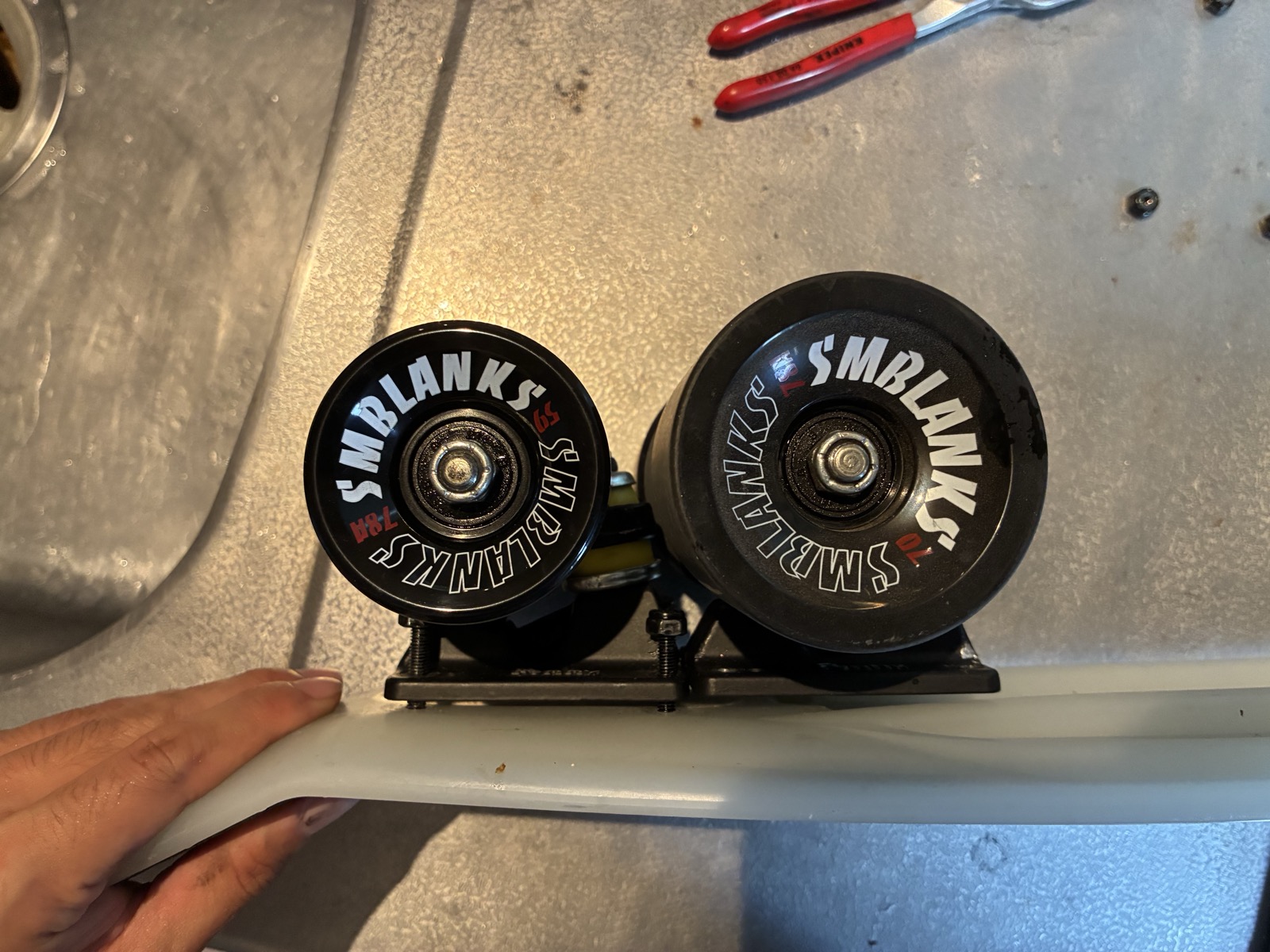
Setups like this cause wheel bite — no gap between wheel and deck.
When opened from the Builder, inputs are pre-filled based on your use case and riser settings. For bolt length only, use the Bolt Length Calculator.
This tool is a setup guide, not a safety guarantee. Test under full lean before riding hard.
Wheel bite happens when the wheel contacts the underside of the deck during a turn or weight shift — causing an abrupt stop. It's most common with large wheels, loose trucks, or narrow decks.
It depends on your wheel size, deck width, and truck tightness. As a starting point: 56mm or smaller on an 8" deck with medium trucks usually needs 1/8" (3mm) or no riser. Larger wheels (58–65mm), softer bushings, or narrower decks typically need 1/4" (6mm) or more. Use the tool above for a setup-specific recommendation.
Yes. A riser raises your center of gravity, which can make the board feel slightly less stable at speed but more responsive to weight shifts. An angled (wedge) riser also changes the effective kingpin angle, which affects how sharply the truck turns.
A flat riser is a uniform-thickness pad — it raises the truck without changing its geometry. A wedge riser has different front and rear thicknesses, which changes the truck's lean angle and turning radius. Wedging the front truck adds responsiveness; wedging the rear adds stability.
Yes. PETG is the most commonly recommended material for outdoor use due to its temperature resistance, and PLA is good for indoor or first test prints. For riding parts, print at 100% infill, use enough walls/perimeters, orient the pad flat on the bed, and inspect for cracks, layer separation, or heat deformation before riding. Use RISER 3D Builder to design your pad with exact height and hole pattern, then export an STL file for printing.
Bolt length needs to increase when you add riser thickness. Use the Bolt Length Calculator to get an exact size based on your deck thickness, riser height, and baseplate.